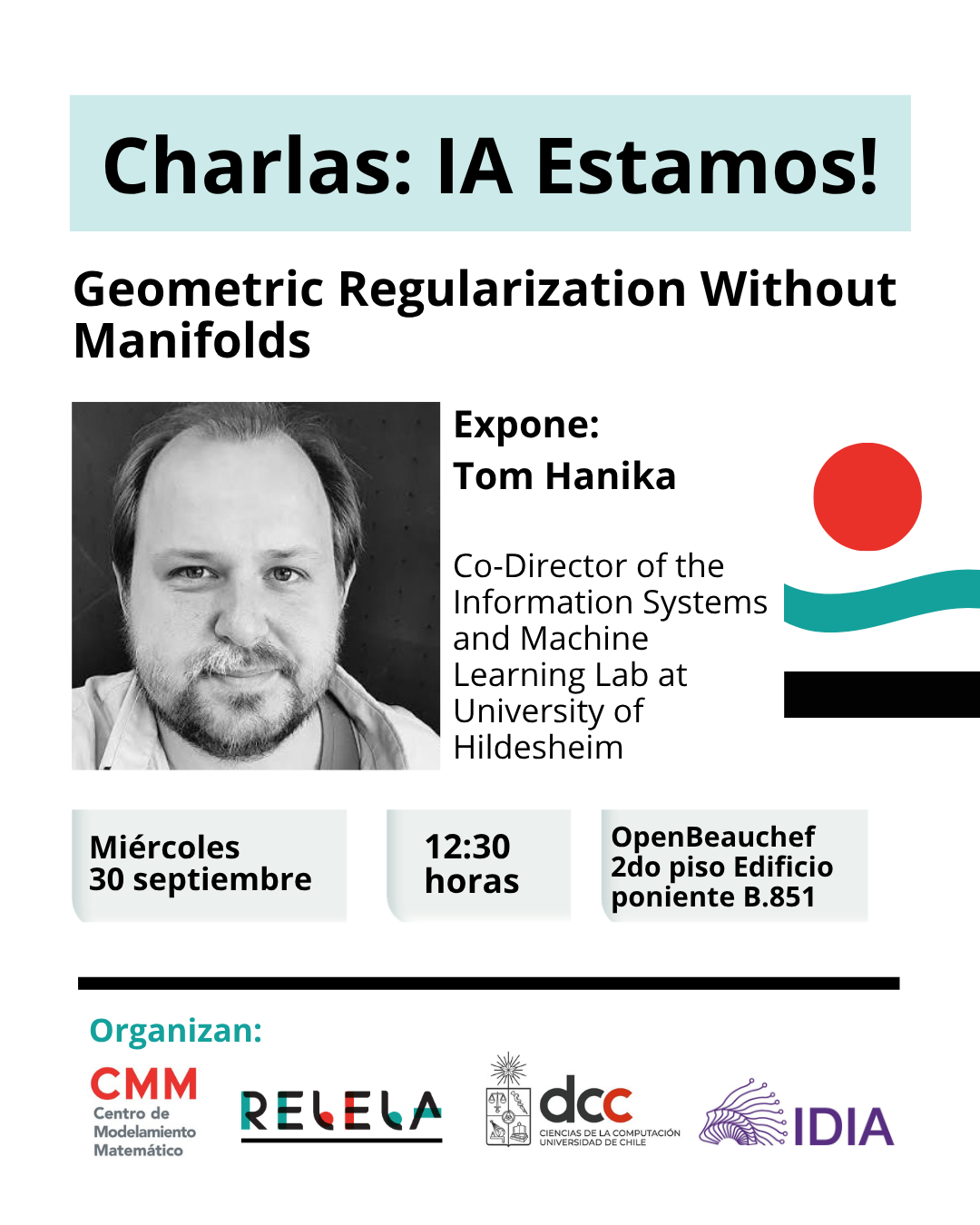
Tenemos el agrado de invitarles a participar en una nueva sesión de la Charla ReLeLa: IA Estamos!.
En esta oportunidad contaremos con la destacada visita internacional de Tom Hanika, Co-Director del Information Systems and Machine Learning Lab de la Universidad de Hildesheim (Alemania), quien nos presentará un innovador enfoque geométrico para la regularización de modelos de machine learning, sin depender de la suposición de variedades (manifolds).
Detalles del Evento
- Nombre de la Charla: Geometric Regularization Without Manifolds
- Expositor: Tom Hanika, Co-Director of the Information Systems and Machine Learning Lab at University of Hildesheim (Sitio web personal).
- Fecha: Miércoles 30 de septiembre de 2026.
- Hora: 12:30 horas.
- Lugar: OpenBeauchef, FCFM, Universidad de Chile (Av. Beauchef 851, Edificio Poniente, Piso 2, Santiago).
Abstract
Regularization controls model complexity, most commonly by adding a penalty to the training objective. One geometrically motivated instance is manifold regularization, which assumes that the data lies near a low-dimensional submanifold and penalizes functions that vary along it. However, this assumption is fragile. In high dimensions, the presumed manifold is difficult to estimate. Furthermore, for non-metric data, the manifold may not even exist.
We propose a regularization approach that maintains the geometric motivation while disregarding the manifold assumption. Our approach is based on the concept of intrinsic dimension, which stems from the concentration of measure phenomenon in metric measure spaces. The central tool in this approach is Gromov's observable diameter, which measures how much of a space's geometry remains visible under real-valued observation. When applied layer by layer to a neural network, the observable diameter yields a computable, distribution-sensitive estimate of the effective degrees of freedom carried by each representation. This approach eliminates the need to posit or reconstruct an underlying manifold.
We use this quantity to regularize learning. It identifies the directions and components that genuinely contribute to the intrinsic dimension per layer. This gives a principled criterion for controlling complexity and pruning overparameterized models. Finally, we relate this layer-wise geometric view to the question of when and why regularization aids generalization.
(This is joint work with Friedrich Martin Schneider and Vladimir Pestov).
Speaker Bio
Tom Hanika is Co-Director of the Information Systems and Machine Learning Lab at University of Hildesheim, Research Associate at University of Kassel and Temporary Lecturer at Humboldt-Universität zu Berlin. His research bridges the mathematical foundations of machine learning with practical applications in explainable Artificial Intelligence. He specializes in the interactive extraction of knowledge from complex explicit and implicit data, ensuring that learning systems are both highly effective and structurally sound.
At the core of his foundational work is the study of semantics arising from implicational theories, with a particular emphasis on the interplay between metrics, orders and measures. He is especially driven by the mathematical challenges of learning in high dimensions, as these push the boundaries of what current machine learning models can achieve. On the applied side, he explores unsupervised learning from large text corpora and actively translates his theoretical methods into real-world solutions. He frequently collaborates to apply explanation techniques across diverse fields, including Biology, Geography, Physics, and the Digital Humanities. Beyond research, he is a senior developer for the social publication sharing system BibSonomy and maintains the Formal Concept Analysis tool conexp-clj.
¡Los y las esperamos para seguir enriqueciendo la discusión sobre los últimos avances teóricos y aplicados en IA!
- Tags