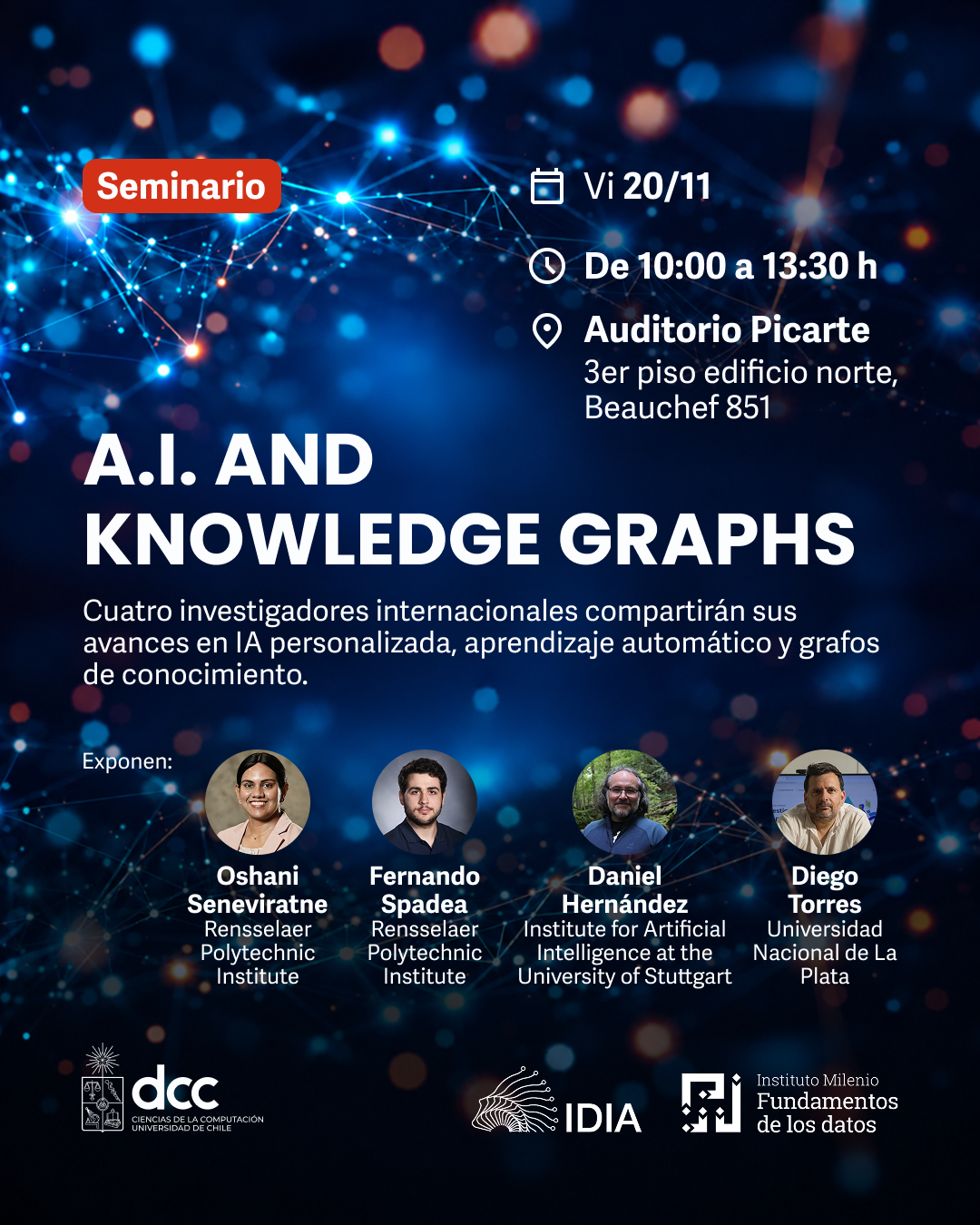
*Seminario en inglés
How can knowledge graphs and A.I. be combined to build more intelligent, adaptive, reliable, transparent and trustworthy systems?
In this seminar, four international researchers will present their latest work on evolving knowledge graphs, personalized A.I., machine learning over structured knowledge, and question answering.
Date: November 20th, 10:00–13:30
Location: Auditorio Picarte, DCC, FCFM, UChile (Beauchef 851, 3° piso, ed. norte)
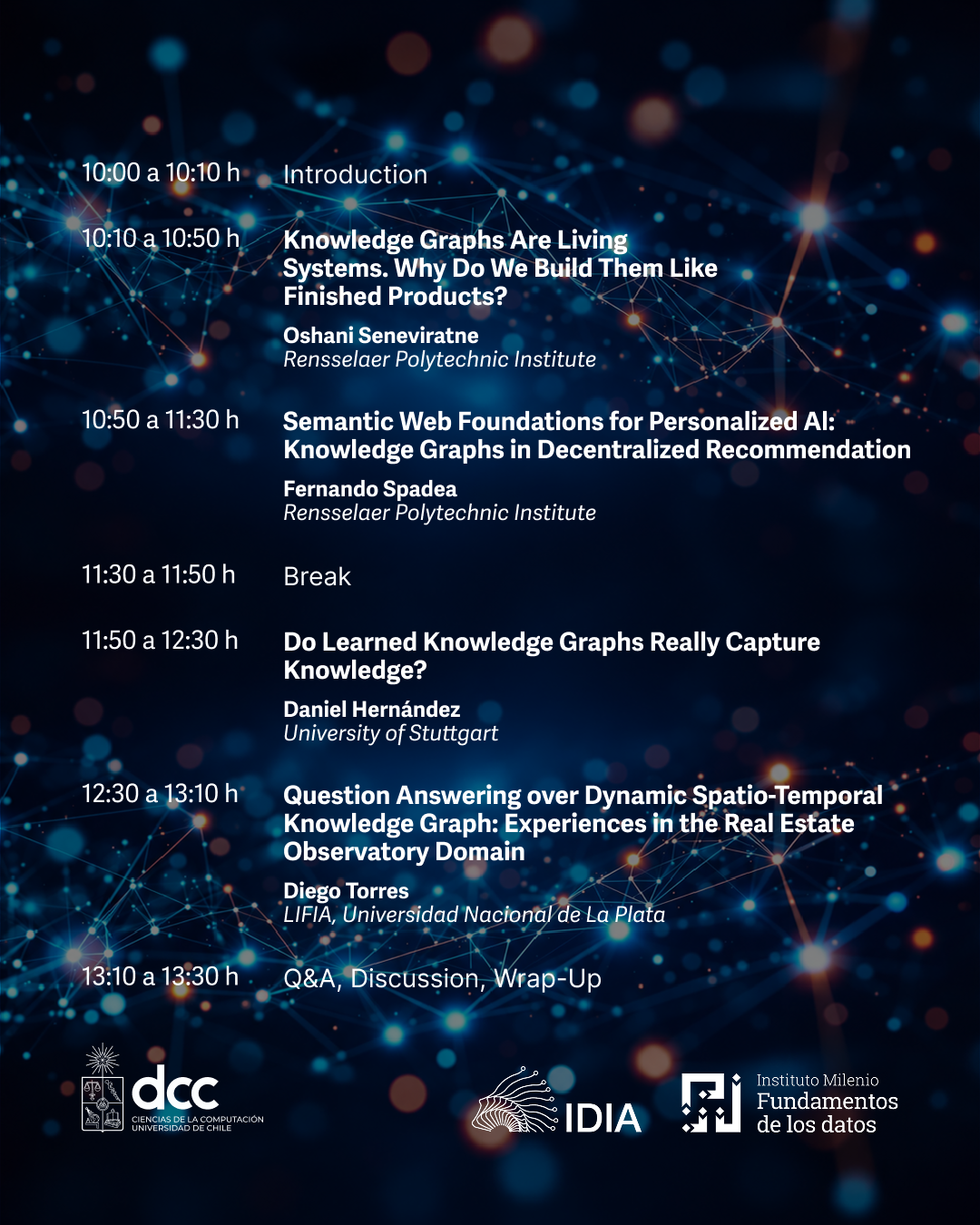
Timetable:
10:00–10:10 | Introduction |
10:10–10:50 | Talk 1 Knowledge Graphs Are Living Systems. Why Do We Build Them Like Finished Products? Oshani Seneviratne – Rensselaer Polytechnic Institute |
10:50–11:30 | Talk 2 Semantic Web Foundations for Personalized Al: Knowledge Graphs in Decentralized Recommendation Fernando Spadea – Rensselaer Polytechnic Institute |
11:30–11:50 | Break |
11:50–12:30 | Talk 3 Do Learned Knowledge Graphs Really Capture Knowledge? Daniel Hernández – University of Stuttgart |
12:30–13:10 | Talk 4 Question Answering over Dynamic Spatio-Temporal Knowledge Graph: Experiences in the Real Estate Observatory Domain Diego Torres – LIFIA, Universidad Nacional de La Plata |
13:10–13:30 | Q&A, Discussion, Wrap-Up |
Talk 1
Title:
Knowledge Graphs Are Living Systems. Why Do We Build Them Like Finished Products?
Abstract:
In this talk, I’ll challenge the idea of a knowledge graph as a finished artifact: what changes when we treat it as a living system? I’ll present three efforts from the BRAINS group that confront the realities of knowledge graphs in practice: building computable knowledge from unstructured documents, answering multi-hop questions across fragmented graphs, and accommodating new entities as graphs grow. The world won’t stop changing. Why should our knowledge graphs?
For more information about the BRAINS group, please see: https://brains.cs.rpi.edu.
Speaker:
Oshani Seneviratne
Bio:
Oshani Seneviratne is an Assistant Professor of Computer Science at Rensselaer Polytechnic Institute, where she leads the BRAINS (Bridging Resilient, Accountable, Intelligent Networked Systems) group. Her research brings together knowledge graphs, Semantic Web technologies, and decentralized AI to advance accountable intelligent systems, with applications in healthcare and finance. She earned her Ph.D. in Computer Science at MIT under the supervision of Sir Tim Berners-Lee. More information about her is available here: https://oshani.info.
Talk 2
Title:
Semantic Web Foundations for Personalized Al: Knowledge Graphs in Decentralized Recommendation
Abstract:
How can personalized AI systems learn from individual users while keeping their data decentralized and grounding their outputs in relevant, structured knowledge? This talk explores that question through a line of research combining knowledge graphs, lightweight large language models, and federated learning. Beginning with evolving personal knowledge graphs for movie and recipe recommendations, the talk will examine how user interactions can support continual, feedback-driven model adaptation without centralizing the underlying data. It will then extend these ideas to financial recommendations, where personal transaction histories and market information are represented as complementary knowledge graphs. Finally, the talk will consider how parallel and multi-stage retrieval using SPARQL can select compact, relevant subgraphs that fit within limited model contexts. Across these settings, the talk highlights the role of Semantic Web technologies in connecting personal and domain knowledge to support grounded, context-aware recommendations.
Speaker:
Fernando Spadea
Bio:
Fernando Spadea is a fifth-year PhD student in Computer Science at Rensselaer Polytechnic Institute, advised by Professor Oshani Seneviratne. His research focuses on personalized recommendations in decentralized systems, particularly in financial and Web3 applications. His work brings together knowledge graphs, open-weight large language models, federated learning, blockchain analytics, and privacy-preserving methods to investigate how intelligent systems can learn from distributed personal and financial data without requiring its centralization. His recent research includes knowledge-graph-grounded recommendations, decentralized model adaptation, and predictive risk management for decentralized finance. More broadly, he aims to develop adaptive systems that preserve user control while providing useful and context-aware recommendations.
Talk 3
Title:
Do Learned Knowledge Graphs Really Capture Knowledge?
Abstract:
Knowledge graph embeddings and knowledge graph foundation models are almost always evaluated on link prediction. That is, building a model to recover a missing fact. Complex query answering builds on it, composing predicted links into logical queries. But do learned knowledge graphs really capture knowledge? By knowledge I mean not only the facts of the ABox, but the TBox of an ontology, its constraints and rules, and beyond. In this talk I will revisit our recent results showing that current evaluations overstate what is learned: complex query answering benchmarks are less complex than they look, and knowledge graph foundation models predict well when the target graph already contains facts about the query's entities and relations, and much less well when it does not, a difference that average scores hide. Large language models learn some knowledge, but a model on its own cannot answer queries that join thousands of existential variables: it has no variable bindings to carry. In contrast, graph-based models score candidate answers to queries of this kind, and they can carry provenance, which allows answers to be explained and, when data is probabilistic, probabilities to be recomputed. The open question is how to learn knowledge, including the TBox, in a form on which such queries can be answered and from which knowledge can be transferred, and how to test that it was learned.
Speaker:
Daniel Hernández
Bio:
Daniel Hernández is a postdoctoral researcher in the Analytic Computing group of the Institute for Artificial Intelligence at the University of Stuttgart. He previously held a postdoctoral position in the Department of Computer Science at Aalborg University and worked at the Millennium Institute for Foundational Research on Data in Chile. He received his Ph.D. in Computer Science from the University of Chile. His research covers the Semantic Web, SPARQL, SHACL, data provenance, ontologies, knowledge graph embeddings, and temporal graphs, with a recent focus on combining logic and learning on knowledge graphs.
Talk 4
Title:
Question Answering over Dynamic Spatio-Temporal Knowledge Graph: Experiences in the Real Estate Observatory Domain
Abstract:
In recent years, a method of data mining and service analysis called Knowledge Base Question Answering (KBQA) has emerged. Given a natural-language question, the KBQA system aims to respond with the correct entities based on a given knowledge base (KB). A specialization within this field is Knowledge Graph Question Answering (KGQA), which uses a knowledge graph (KG) as its knowledge source and leverages triples stored in the KG to answer natural-language questions. This talk will describe findings and challenges in combining KGQA with large language models (LLMs) and developing benchmarking methods to analyze these approaches' capabilities.
Speaker:
Diego Torres
Bio:
Diego Torres holds a Ph.D. in Computer Science from the National University of La Plata (Argentina) and a Ph.D. from the University of Nantes (France), based on his dissertation titled “Co-evolution between the Social Web and the Semantic Web.” He is a researcher at LIFIA Lab in the Facultad de Informática at UNLP. His research interests include Knowledge Management, the Semantic Web, Knowledge Graphs, Adaptive Gamification, and applications in Open Science and Citizen Science. His primary applications involve using data for decision-making in urban planning, agriculture, and requirements analysis. He is currently a Full Professor teaching the courses “Object-Oriented Programming 1” and “Semantic Web and Knowledge Graphs” in the School of Computer Science at UNLP. He is also an Associate Professor in the “Object-Oriented Programming 2” course at the National University of Quilmes.
--
Comunicaciones DCC
- Tags